When most people hear “geothermal energy,” they think of Iceland, Yellowstone, or hot springs — places where the earth’s heat is practically boiling up through the ground on its own. For decades, that image was essentially correct: traditional geothermal power only worked where nature had already done the hard work. But a wave of new technology borrowed directly from the oil and gas industry is changing everything. In this episode, we discuss the rapid advances in Enhanced Geothermal Systems (EGS) — what they are, how far the technology has come since we first covered this topic in Episode 158 back in 2022, and most importantly, what the legal ownership picture looks like for mineral rights owners as this new energy source begins to scale up.
The sponsor for this episode is SS&C MineralWare:

MineralWare is the leading asset management platform trusted by thousands of mineral rights owners for managing minerals, royalties, and non-operated working interests. Know in seconds where your leases are, what’s active, what acreage is open for lease, and if you are getting paid what you’re owed. See a demo today by visiting mineralware.com.
Be sure to also subscribe on Apple Podcasts via the link above and please leave us an honest rating and review. We read every one of them and sincerely appreciate any feedback you have. To ask us a question to be featured on an upcoming episode, please leave a comment below or send an email to feedback@mineralrightspodcast.com.
What Is Traditional Geothermal Energy — and Why Has It Been So Limited?
Traditional geothermal power plants work by tapping into naturally occurring heat close to the earth’s surface — places where hot water or steam is already in motion underground. You drill a well, the steam comes up, spins a turbine, and generates electricity. It is the same basic principle as a coal plant or a nuclear plant — heat creates steam, steam creates power — except the fuel is free and inexhaustible. What makes geothermal uniquely valuable is that it produces power 24 hours a day, seven days a week, regardless of weather. That kind of reliable, around-the-clock electricity is called “baseload” or “firm” power, and it is something that solar panels and wind turbines simply cannot provide on their own.
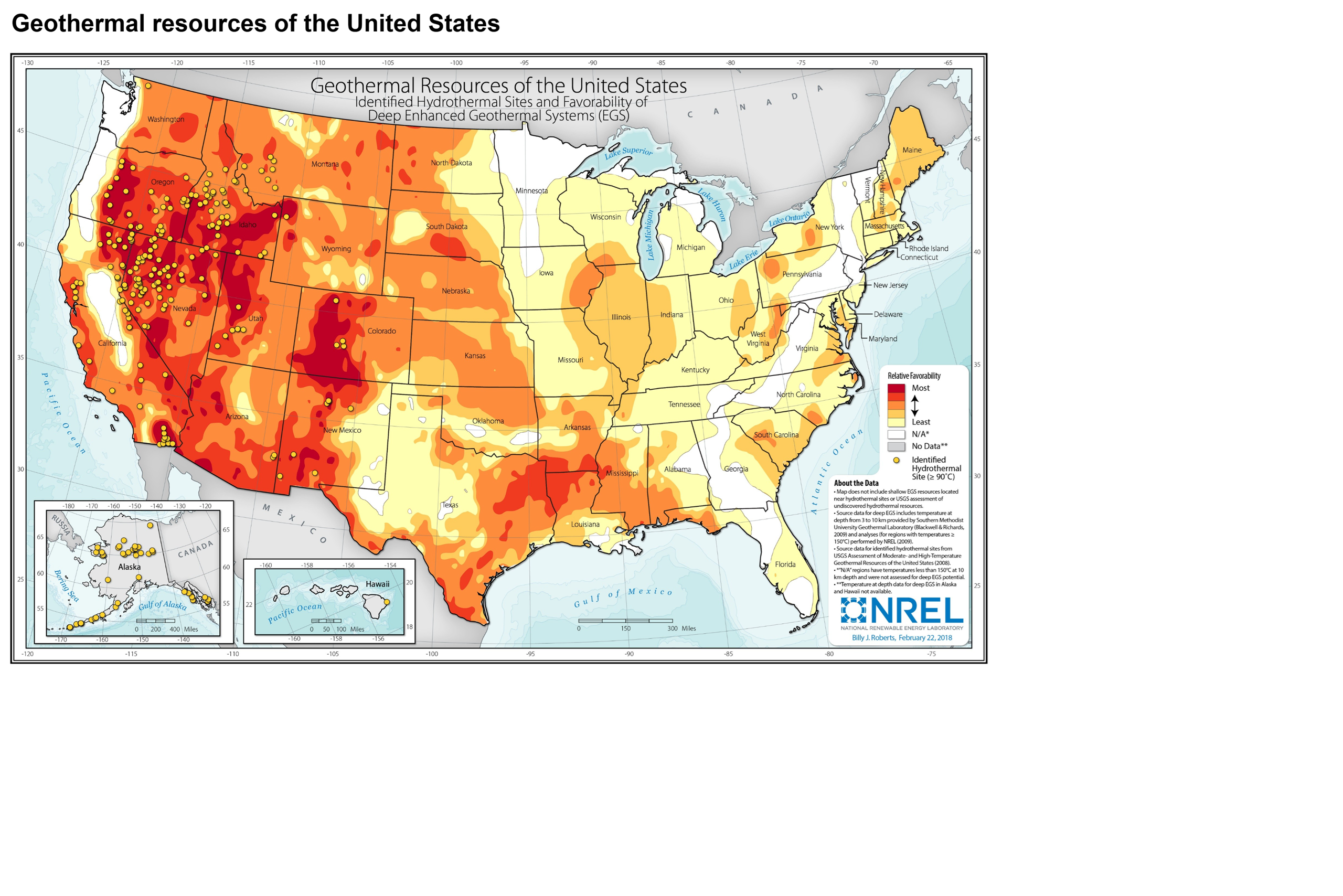
The catch is geography. Traditional geothermal requires three things to come together naturally: hot rock, water, and permeable rock that allows water to circulate. That combination only exists in a handful of places — the Pacific Ring of Fire, Iceland, Hawaii, and the western United States. As a result, about 95% of the country’s current geothermal capacity is concentrated in California and Nevada, and the total amount of geothermal electricity being generated in the entire U.S. is only about 4 gigawatts — roughly equivalent to four large nuclear reactors running at full power.
What Is an Enhanced Geothermal System (EGS)?
EGS is the answer to that geographic limitation. Instead of hunting for places where nature already provided all the ingredients, engineers build the missing pieces themselves. The process works like this: drill a well deep into hot, dry rock; pump water down under high pressure to create tiny fractures in the rock (using the same hydraulic fracturing technology developed for shale oil and gas); those fractures create a pathway for water to flow and absorb heat; a second well is drilled nearby to bring the heated water back to the surface; that hot water flashes into steam and spins a turbine to generate electricity; and the cooled water is recycled back underground to start the process again. It is a closed-loop system that, in theory, can be installed anywhere the ground is hot enough — which is almost everywhere, if you drill deep enough.
The connection to the oil and gas industry is clear. Horizontal drilling, multistage hydraulic fracturing, fiber-optic downhole sensing, and the experienced workforce to run it all — every one of these tools came directly from decades of shale development. In fact, according to Fervo Energy, their Cape Station project in Utah, oil and gas workers have accounted for more than 90% of the labor hours on site.
How Far Has EGS Come Since We Last Covered This in 2022?
When we first discussed geothermal energy in Episode 158, EGS was a promising but mostly unproven concept at a commercial scale. There were a handful of small pilot projects and a lot of optimism about the oil-and-gas technology transfer, but nobody had actually done it at a scale that could power real homes and businesses. That has changed in just a few short years.
Fervo Energy, a Houston-based startup, has been the company at the forefront of this transformation. In July 2023, they completed the world’s first successful commercial EGS pilot using horizontal drilling at its Project Red site in northern Nevada. Their 30-day well test set new records for flow rate and power output, and by November 2023 the project was sending carbon-free electricity to the grid that powers Google’s data centers in Nevada. Then, in September 2024, Fervo reported results from its flagship 400-megawatt Cape Station project in Beaver County, Utah. A single production well achieved flow rates that could generate over 10 megawatts — triple the per-well output from Project Red just one year earlier. Fervo’s chief technology officer described the moment as their “Mitchell Energy moment” — a reference to the company widely credited with cracking the code on horizontal drilling and hydraulic fracturing in the 1990s and launching the shale revolution. The comparison is significant: if successful, it suggests the geothermal industry may be on the same steep learning curve that transformed U.S. oil and gas production over the past two decades.
The Department of Energy has also been running its own research site called FORGE (Frontier Observatory for Research in Geothermal Energy) in Milford, Utah, conducting long-term flow tests to confirm the stability of engineered geothermal reservoirs. Between FORGE’s research results and Fervo’s commercial milestones, the technology targets that the National Renewable Energy Laboratory originally set as goals for 2035 are already being met — ahead of schedule.
How Big Could Geothermal Actually Get?
The numbers in play are substantial. The Department of Energy’s Enhanced Geothermal Shot™ analysis projects that geothermal could deliver at least 90 gigawatts of electricity-generating capacity in the United States by 2050. That would be enough to power more than 65 million American homes — roughly half of all households in the country — and would represent a more than twenty-fold increase from where geothermal capacity stands today. Even more optimistic estimates from the U.S. Geological Survey suggest the Great Basin region of the American Southwest alone could support up to 135 gigawatts of EGS capacity.
One important and underappreciated driver of growth is the explosion in power demand from artificial intelligence and data centers. Data centers need electricity that never goes off, and geothermal fits that profile better than solar or wind. Google’s early investment in and partnership with Fervo was specifically driven by the need for 24/7 carbon-free power. As that demand accelerates, so will the capital flowing into geothermal.
That said, the challenges are real. EGS wells are expensive to drill — often more so than oil and gas wells because they go deeper and into harder rock. Water use is a genuine constraint, particularly in the American Southwest, where some water injected into rock formations is not fully recovered. Induced seismicity — small earthquakes triggered by injecting water at high pressure — must be carefully managed. Permitting on federal land can take a decade or longer. And there is no established market rate for geothermal royalties, which creates uncertainty for landowners considering leasing their rights.
Who Legally Owns Geothermal Rights — Surface Owner or Mineral Owner?
This is the question that matters most to mineral rights owners, and the honest answer is: it depends entirely on which state you are in, and the legal landscape has been changing.
In oil and gas, ownership is generally clear — whoever holds the mineral rights owns the oil and gas beneath the land. Geothermal energy is legally different because it is not a traditional mineral. It is heat. And heat does not fit neatly into the centuries of property law built around oil, gas, coal, and metals. The result is a patchwork of state laws, court rulings, and new legislation that varies dramatically from one state to the next.
Three states — California, Hawaii, and New Mexico — treat geothermal rights as part of the mineral estate. If you own the mineral rights in those states, you likely also own the right to lease geothermal development and collect a royalty on it. However, in Nevada, Oregon, and Texas, geothermal rights belong to the surface estate — meaning the person who owns the surface of the land controls geothermal development, even in a split estate where the minerals have been severed. In Alaska, Wyoming, and parts of Utah, geothermal is classified as part of the water rights framework rather than mineral rights. And in many other states, no clear guidance exists at all, leaving the question to be resolved case by case in the courts.
The most significant recent development is Texas. When we last covered geothermal in 2022, the existing Texas law — dating back to the 1970s — had declared the mineral estate as owning the geothermal rights, which was good news for the many Texas mineral owners in a split estate situation. In 2023, Texas Senate Bill 785 reversed that. The law now clearly states that the surface owner, not the mineral estate owner, controls geothermal energy and associated resources. While this makes intuitive sense — since geothermal development mostly involves drilling, water injection, and surface infrastructure rather than extracting minerals — it is still a meaningful setback for mineral-only owners in Texas.
The broader legislative trend appears to be moving toward the surface estate, which means that mineral owners who do not also own the surface are likely to find themselves without a seat at the table in most states where geothermal develops. If you own both surface and mineral rights, you are in a much stronger position.
The Hidden Complication: What About the Minerals in the Brine?
Even in states where geothermal rights follow the surface estate, there is a separate and unresolved ownership question that could matter a great deal to mineral rights owners: what about the valuable minerals that come up with the water?
When EGS wells circulate water through deep hot rock, that water does not come back up pure. It returns loaded with dissolved minerals — including some potentially valuable minerals. For example, if geothermal energy is developed in an area with rich lithium deposits, this could be an issue. A technology called Direct Lithium Extraction (DLE) can filter lithium directly out of geothermal brine at the surface — quickly and with a much smaller footprint than traditional mining — and it is being actively commercialized right now in places like Arkansas.
The legal question of who owns that lithium is genuinely unsettled. In Texas, recent legal analysis suggests that lithium dissolved in brine would likely be classified as part of the mineral estate — because lithium is clearly a mineral by any ordinary definition. But the brine water itself (the liquid in which the lithium is dissolved) is treated as belonging to the surface estate. That creates a direct conflict: the mineral owner may have a claim to the lithium, while the surface owner controls the water it is dissolved in. In California and New Mexico, where geothermal rights follow the mineral estate, mineral owners may have a stronger claim to both the heat and the co-produced minerals. In most other states, no one really knows yet — there is simply no case law on the books.
What Mineral Owners Should Do Now
Know what you own. Understand whether you hold only mineral rights, only surface rights, or both. That distinction drives everything about your position in a geothermal situation. If you aren’t sure where to start, check out my Mineral Management Basics Course.
Know your state’s law. Check whether your state has a geothermal statute and how it classifies ownership. The answer directly determines whether you have any claim to geothermal development or royalties.
Review your existing lease language. Oil and gas leases were written with oil and gas in mind and almost never mention lithium or other minerals dissolved in produced water. If your lease is silent on associated minerals, that ambiguity could become a problem — or an opportunity — as geothermal brine becomes commercially significant.
Watch state legislation. Multiple states are actively passing or considering geothermal ownership statutes right now. If you see legislation being proposed in your state, it is worth understanding it and, where possible, providing comment.
Consult an attorney before signing anything. Geothermal leasing is a new and unsettled area of law. There is no standard royalty rate, no established set of normal terms, and no large body of case law to lean on. If a developer approaches you with a lease, the cost of a consultation is small compared to what you could give up by signing uninformed.
Resources
- MRP 158: Geothermal Energy Opportunities
- Fervo Energy (Project Red and Cape Station)
- DOE Enhanced Geothermal Shot™ Analysis
- DOE FORGE Research Site (Utah)
- EIA — Enhanced Geothermal Systems Overview
- SPE/JPT — “Who Holds the Rights to Geothermal Heat Sources?”
- Texas Senate Bill 785 (2023 Geothermal Ownership)
- Baker Botts — Lithium Ownership Analysis in Texas
- Mineral Management Basics Course
Thanks for Listening!
To share your thoughts:
- Leave a comment or question below (we read each one and your question may be featured in a future episode)!
- Ask a question or leave us feedback via email.
To help out the show:
Click the Apple Podcasts Logo Above to leave us a rating & review. It really helps us reach those that need to hear this information and only takes a minute. We greatly appreciate it! Plus, you can get a shout out on a future episode!
Thanks again – until next time!
Disclaimer: This episode and accompanying show notes are provided for general information purposes and should not be construed as financial, legal, or investment advice. For guidance specific to your situation, please consult with a qualified attorney, CPA, or financial advisor.