
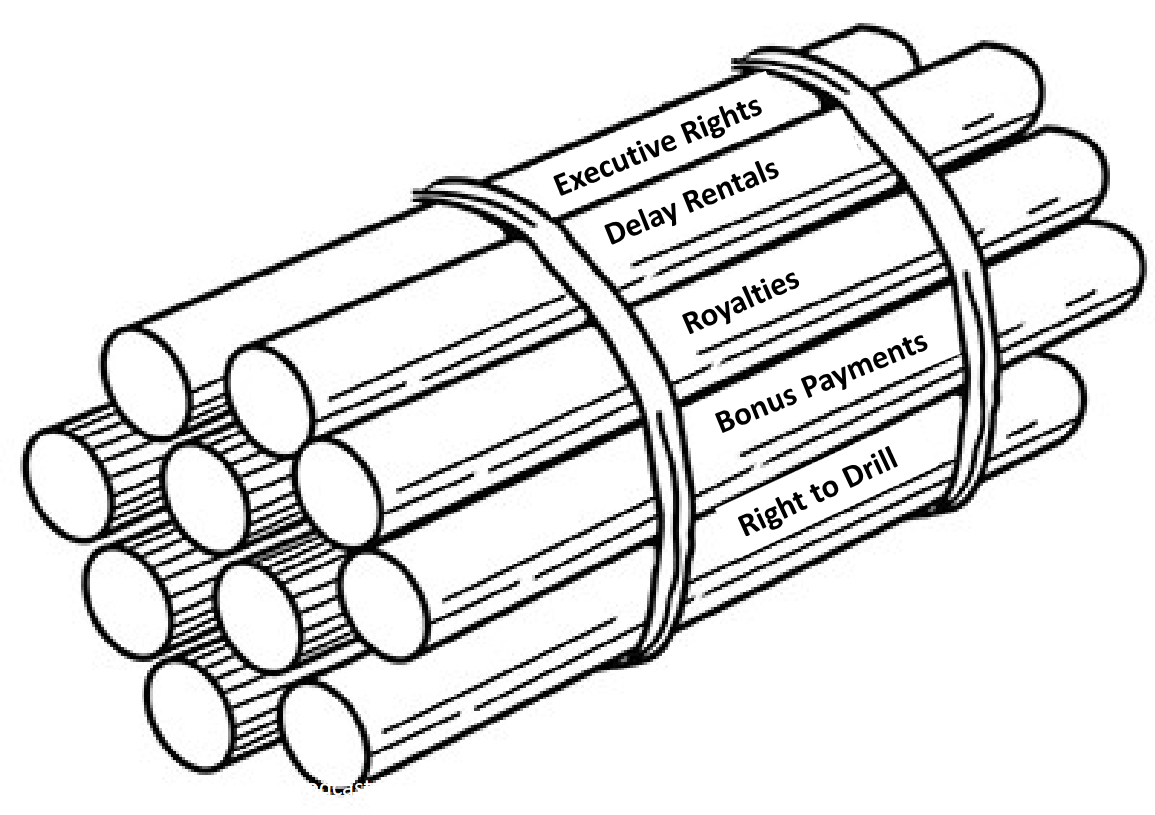
Most mineral owners know they “own mineral rights” — but what does that actually mean? Property ownership isn’t a single thing; it’s a collection of separate, stackable, and separable rights that attorneys and landmen refer to as the “bundle of sticks.” In this episode, we break down everything you need to know about the different types of property rights — from the broad concept of who owns what on the surface to a detailed look at the five distinct rights that make up the mineral estate itself. If you’ve ever wondered why you’re receiving a royalty check but didn’t sign a lease, why you can sell your interest while your cousin holds onto theirs, or what exactly an NPRI owner does and doesn’t get to do — this episode covers it all. Whether you’ve just inherited minerals or have been a mineral owner for years, understanding which “sticks” are in your bundle is foundational to making informed decisions about your property.
Be sure to also subscribe on Apple Podcasts via the link above and please leave us an honest rating and review. We read every one of them and sincerely appreciate any feedback you have. To ask us a question to be featured on an upcoming episode, please leave a comment below or send an email to feedback@mineralrightspodcast.com.
The Three Types of Land Ownership
The starting point for understanding mineral rights is understanding how property works at the broadest level. All property ownership usually flows from the concept of “fee simple” — owning the full bundle of all rights, including the surface and everything beneath it. From that starting point, rights can be separated and held independently. A surface-only owner controls the dirt, structures, and crops on the land but has no claim to what’s underneath. A severed mineral rights owner, on the other hand, owns the subsurface but may never have set foot on the land itself. A critical — and often misunderstood — point here is that the mineral estate is the “dominant estate.” This means that if your minerals are severed from the surface, the mineral owner (or an operator holding a lease from you) has the legal right to reasonably access and use that surface to develop the minerals, even without the surface owner’s permission. In practice, operators approach surface owners about surface use agreements to set terms and provide compensation for the impact to the land — but the legal right to develop belongs to the mineral estate.
What Makes Mineral Rights Different: The Undivided Interest
One of the most practical — and often confusing — aspects of mineral ownership is the concept of undivided interests. Unlike surface land, where boundaries are physical and visible, mineral rights are shared ownership of the same subsurface pool. If your grandfather left his minerals equally to his two grandchildren, each grandchild doesn’t own the minerals under the eastern or western half of the property — they each own 50% of all the minerals under all of the property. This is what “undivided” means. And critically, each owner’s interest is independent: you can lease your share, sell your share, or leave it to your heirs — regardless of what any co-owner wants to do with theirs. As I explain in this episode, that independence is a feature, not a bug. As mineral interests get subdivided further with each generation, the ability to act independently on your own fractional share keeps things from grinding to a halt.
The Five Rights of the Mineral Estate
The heart of this episode is a detailed walkthrough of the five distinct rights that make up the mineral estate — the “sticks” within the mineral portion of the bundle. The right to develop (or right to drill) is the foundational right to actually go in and extract oil and gas from the land. Most mineral owners never exercise this directly; instead, they transfer it to an oil company through a lease. The executive right — arguably the most powerful stick — is the right to negotiate and sign an oil and gas lease. Whoever holds the executive right sits across the table from the oil company and determines the royalty rate, the bonus, and the lease terms. In my experience, it’s possible to own the other four rights but not the executive right, which puts you entirely at the mercy of someone else’s negotiating. Sticks three and four — the right to receive a bonus payment and the right to receive delay rental payments — are the upfront financial benefits of signing a lease. Bonus payments are taxed as ordinary income in the year received, and while separate delay rentals are uncommon in modern paid-up leases, they still appear in older instruments and title searches. The fifth and most valuable stick for most mineral owners is the right to receive royalty payments: the ongoing share of production revenue, free of drilling and operating costs, that flows from every barrel or MCF produced from your leased minerals. Did you know that the royalty rate, not the bonus payment negotiated in your lease directly determines the long-term value of your mineral interest — a point that should shape every leasing negotiation.
Types of Mineral Interests: What You Might Actually Own
These five rights don’t always travel together, and different combinations give rise to different types of mineral interests. A full mineral estate (non-producing) means you own all five sticks and no lease is currently in place — you have the full power to negotiate a lease if a company approaches you. A producing mineral/royalty interest means you own all five sticks and are actively receiving royalties under a current lease. An undivided mineral interest is a fractional ownership share in all the minerals under a tract, alongside co-owners. And then there’s the Non-Participating Royalty Interest (NPRI) — a royalty interest carved out of the mineral estate that holds only one stick: the right to receive royalties. NPRI owners don’t sign leases, don’t receive bonus payments, and don’t have any say in the leasing process. Within NPRIs, there’s an important further distinction between fixed and floating NPRIs: a fixed NPRI entitles the owner to a set fraction of total production regardless of the lease royalty rate, while a floating NPRI entitles the owner to a fraction of whatever royalty rate was negotiated in the lease — a distinction that can mean the difference between receiving 20% and 5% of production from the same well. (For a full treatment of this topic, see MRP 263: What You Should Know About Fixed vs. Floating NPRI’s.). Most of the type the NPRI amount is a small fraction of the overall mineral estate but that doesn’t have to be the case.
When You Sign a Lease: Leasehold Interests and Who Else Gets Paid
When a mineral owner signs an oil and gas lease, a whole new set of interests is created — entirely separate from the mineral estate. These are called leasehold interests or working interests. The operator (or operated working interest owner) is the company that actually drills and runs the well, manages all equipment and day-to-day operations, and passes along costs to other interest owners. Non-operated working interest owners are investors in the lease who participate financially in drilling and operating costs but don’t run the operation themselves. Note that mineral owners who are force pooled can end up as non-operated working interest owners. Finally, an overriding royalty interest (ORRI) is a royalty carved out of the working interest — not the mineral estate — and often used to compensate landmen, geologists, or deal participants. A critical difference: mineral rights are perpetual, but an ORRI expires the moment the underlying lease does. When a well is producing, every dollar of revenue is divided proportionally among all of the mineral and working interests — and it all has to add up to 100%.
How to Figure Out What You Actually Own
We close the episode with practical advice on how to determine exactly which sticks are in your bundle. A quick starting point is your royalty check stub: it will typically show a code indicating whether your interest is a royalty interest (RI), an override (OR), or a working interest (WI). A more complete picture requires a title search — reviewing the chain of deeds back to the original government patent to identify any interests that were carved out or retained along the way. If an ancestor sold minerals but retained an NPRI, or if an executive right was separated from the rest of the bundle, a title search will reveal it. You can also request a redacted copy of the title opinion from the operator, though they may or may not provide it. As Justin puts it, your chain of title is specific to your property — which means the only way to truly know what you own is to look at your specific documents.
Resources
- MRP 2: What’s the Difference Between Minerals and Royalties?
- MRP 7: Working Interests for Mineral Owners
- MRP 8: Forced Pooling – What are Your Options?
- MRP 43: Overriding Royalty Interests
- MRP 66: Dormant Mineral Rights. Do Mineral Rights Expire?
- MRP 263: What You Should Know About Fixed vs. Floating NPRI’s
- Join NARO — Use code MRPODCAST for $25 off your first year of membership
- My Mineral Management Basics Course — In this episode we start with one of the foundational concepts that I explain in detail in my Mineral Management online course. If you found this episode helpful, check it out to cut through the confusion so you can know exactly what you own, how to perform a title search, and how to identify nearby activity or the important documents and
- NARO (join-naro.org) — National Association of Royalty Owners; use code PODCAST at checkout for $25 off your first year of membership
Thanks for Listening!
To share your thoughts:
- Leave a comment or question below (we read each one and your question may be featured in a future episode)!
- Ask a question or leave us feedback via email.
To help out the show:
Click the Apple Podcasts Logo Above to leave us a rating & review. It really helps us reach those that need to hear this information and only takes a minute. We greatly appreciate it! Plus, you can get a shout out on a future episode!
Thanks again – until next time!
Disclaimer: This episode and accompanying show notes are provided for general information purposes and should not be construed as financial, legal, or investment advice. For guidance specific to your situation, please consult with a qualified attorney, CPA, or financial advisor.