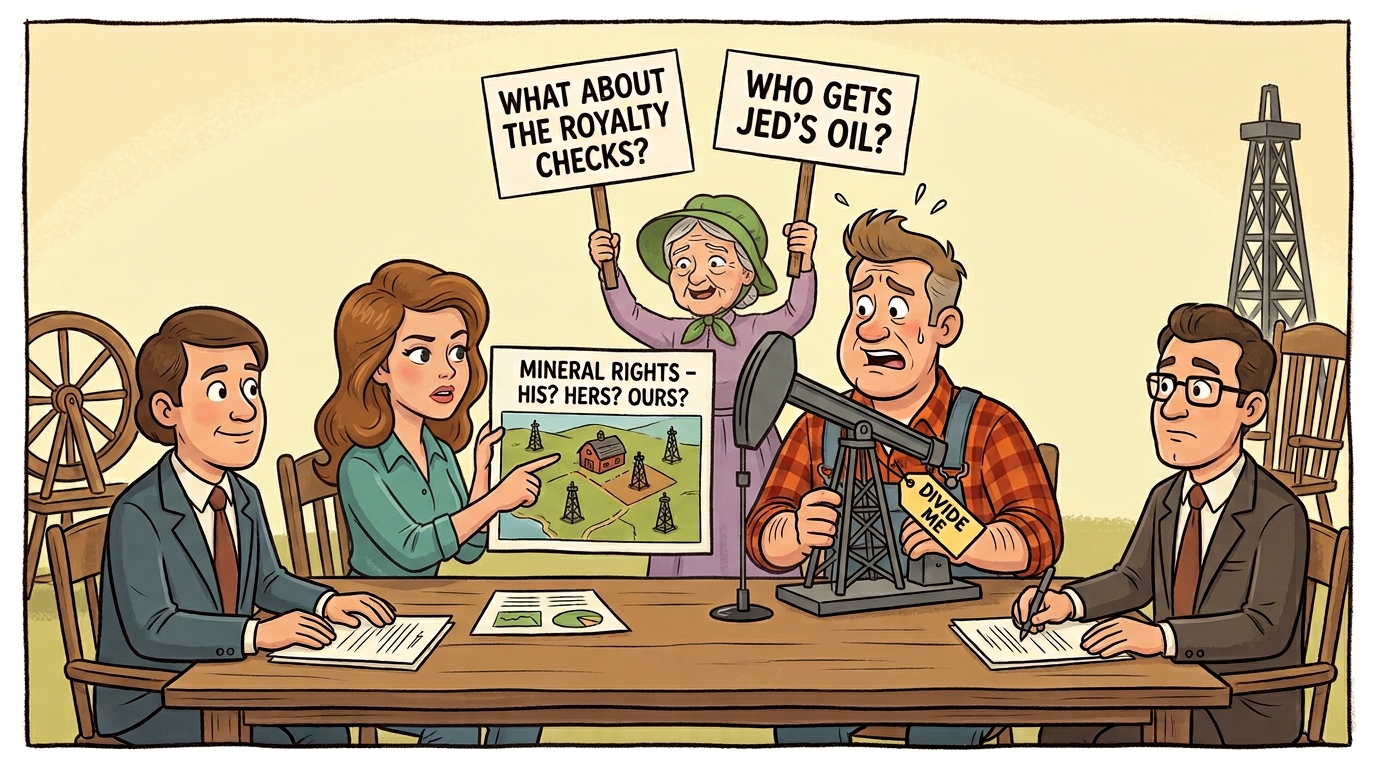
Imagine you inherited 200 mineral acres from your grandfather in Oklahoma, but you live in Arizona. Years down the road, you go through a divorce. Does your spouse have any claim to those minerals? The honest answer is: it depends on the state where the minerals sit, the state where you and your spouse live, how carefully you’ve kept things separate over the years, and sometimes on all three at once. In this episode, we take on one of the most complex legal topics we’ve ever covered on the show: what actually happens to individually owned mineral rights during a divorce. We walk through the difference between community property and equitable distribution states, why Texas and Louisiana, two neighboring, oil-rich community property states, treat the exact same royalty check in opposite ways, why North Dakota doesn’t automatically shield inherited minerals the way you might assume, and what happens when the state you live in and the state your minerals sit in don’t play by the same rules. If you’re the steward of a family mineral legacy and want to understand what’s really at stake — and what you can actually do about it — this one’s worth your full attention. One important note up front: neither Justin nor I are attorneys, and nothing here should be construed as legal advice. This is genuinely fact-specific and state-specific territory, so if it applies to your situation, please talk to a qualified family law attorney.
Using the embedded player above, you can download the episode to your computer or listen to it here!
Be sure to also subscribe on Apple Podcasts via the link above and please leave us an honest rating and review. We read every one of them and sincerely appreciate any feedback you have. To ask us a question to be featured on an upcoming episode, please leave a comment below or send an email to feedback@mineralrightspodcast.com.
Community Property vs. Equitable Distribution
There are really two systems at play across the country. Nine states — including three of the biggest oil and gas producers, Texas, New Mexico, and Louisiana — use community property rules, where anything either spouse acquires during the marriage is owned 50/50 regardless of whose name ends up on the deed. The other 41 states, which includes Oklahoma, Colorado, Utah, and North Dakota, use equitable distribution instead, where marital property gets divided fairly, but not necessarily equally, and a court has real discretion in how it draws that line. This distinction matters well beyond divorce, too. I’m currently helping a client work through a title dispute that traces back to a conveyance where, because the minerals were in a community property state, both spouses should have signed the deed and only one did — and now buyers of a later interest are trying to unwind the whole chain because of it. Whether you’re thinking about divorce or not, knowing which system governs your minerals is a basic fact worth having on hand.
“Separate Property” Isn’t Always as Separate as You Think
It’s easy to assume that minerals you inherited before or during a marriage are automatically separate property and off the table — but that assumption gets tested the moment income starts flowing. If you deposit royalty checks into a joint account, use them to pay joint household bills, or reinvest them into jointly titled assets, you can commingle that income to the point where it’s no longer clearly separate. And if your separate-property claim is ever challenged, the burden falls on you to prove it, with documentation like deeds, dates, and bank records that show the money was genuinely kept apart the whole time. It’s also not just royalty income you have to think about. In a state like Texas, for example, bonus payments and delay rentals can be treated completely differently than the royalty generated by the same separate-property minerals, which was a surprise to us as we dug into the research for this episode.
Texas and Louisiana Play by Opposite Rules
Of the three big oil-producing community property states, Texas and Louisiana turned out to be the most interesting contrast in the whole episode. In Texas, if the underlying minerals are separate property, the royalty they generate generally stays separate too — but bonus payments and delay rentals are treated as community property regardless of whether the minerals themselves are separate or shared. Louisiana runs the opposite default: royalties, bonuses, delay rentals, and shut-in payments from separate-property minerals are all community property unless a spouse takes a specific legal step to reserve them, through a formal written declaration delivered to the other spouse and filed in the parish records. So the exact same royalty check could be treated in opposite ways depending on which side of the Texas-Louisiana border your minerals happen to sit on. New Mexico, the third major community property oil state, doesn’t have a mineral-specific rule like either of these — royalty income there just falls under the state’s general tracing principles for separate property.
Oklahoma, Colorado, Utah, and North Dakota Each Handle It Differently
Moving over to the equitable distribution states, the analysis shifts from “is this separate or community property” to a broader set of factors a court weighs to reach a fair outcome. In Oklahoma and Utah, the key question often becomes whether an increase in the value of separate-property minerals came from passive market forces — commodity prices rising, nearby development you had nothing to do with — which tends to stay separate, or from active effort and marital funds, which can pull that value into the marital estate. Colorado draws a sharper distinction worth understanding on its own: the mineral interest itself can remain separate property, while any increase in its value during the marriage is treated as marital property subject to division — two genuinely different questions that are easy to conflate. North Dakota is interesting given how much value Bakken minerals have generated; we expected inherited minerals to be more clearly protected there, but North Dakota actually treats all property held by either spouse, inherited or not, before the marriage or during it, as presumptively part of the marital estate, subject to the court’s discretion. Origin is a factor the court considers, not an automatic exclusion — which means you shouldn’t assume inherited North Dakota minerals are untouchable without doing the work to document and support that position.
Living in One State, Owning Minerals in Another
Here’s where things get genuinely complicated: most mineral owners don’t actually live in the state where their minerals are located. When that state uses a different property system than your home state, a single divorce case can end up applying two different states’ rules to two different assets at the same time. Texas, New Mexico, and Louisiana each have their own specific — and different — approaches for handling property acquired while living elsewhere. Texas will treat property acquired out of state as if it were community property if it would have qualified that way had you been domiciled in Texas at the time; New Mexico’s version of this rule only kicks in if both spouses are still domiciled there at the time of divorce; and Louisiana has gone as far as writing this scenario directly into its statutes rather than leaving it to case law, with its own layered set of rules for who gets what based on where the property was acquired and where the couple lives now. If your minerals and your home state don’t line up, you may genuinely need an attorney in both states, not just one.
Protecting a Family Legacy
If you’re thinking about this less as a hypothetical and more as a question of stewardship for something that’s been in your family for generations, there are real, practical steps worth taking. Putting minerals into a trust or an LLC doesn’t automatically make them divorce-proof — the same commingling questions still apply, and the more personal control and involvement you retain over that asset, the more exposed it can be; genuine separation seems to matter more than the legal structure itself. A prenuptial agreement is probably the most direct form of protection available, but it has to be properly drafted, fully disclosed, and correctly executed to hold up, and it’s a conversation far better had before a wedding than after one. Beyond that, the basics matter more than people expect: keep inherited mineral interests titled solely in your name, keep the supporting paperwork retrievable, and keep royalty income from separate property in its own account rather than a joint one. And if a divorce does happen, mediation gives you meaningfully more control over the outcome than leaving a genuinely ambiguous area of law up to a judge’s discretion — which, as we found researching this episode, happens more often than you’d think.
As always: Justin and I are not attorneys, CPAs, or financial advisors, and nothing in this episode should be taken as legal advice. Every one of these state rules is fact-specific and subject to change, so if any of this applies to your situation, please talk to a qualified family law attorney licensed in your state — and ideally one who also understands oil and gas property. NARO’s business supporter directory is a good place to find one.
Resources Mentioned in This Episode:
- MRP 39: Mineral Rights Inheritance
- MRP 85: Probate and Marketable Title with Attorney Richard Winblad
- MRP 274: Protect Your Legacy: Smart Estate Document Storage
- MRP 311: Probate and Inherited Mineral Rights: Requirements and Alternatives
- Texas Family Code §§ 3.001–3.003 — Texas’s separate property, community property, and presumption-of-community-property rules
- Texas Family Code § 7.002 — how Texas courts treat property acquired while domiciled in another state
- NMSA 1978 § 40-3-8 — New Mexico’s separate, community, and quasi-community property rules
- Louisiana Civil Code Article 2339 — Louisiana’s default community-property treatment of mineral royalties, bonuses, delay rentals, and shut-in payments from separate property, plus the reservation process
- Louisiana Civil Code Article 3525 — Louisiana’s rule for property acquired out of state by a Louisiana-domiciled spouse
- Louisiana Civil Code Article 3526 — Louisiana’s rule for property acquired while domiciled elsewhere, where the couple is now Louisiana-domiciled at divorce
- Oklahoma Statutes Title 43, § 121 — Oklahoma’s equitable distribution standard
- Colorado Revised Statutes § 14-10-113 — Colorado’s disposition of property statute, including the increase-in-value rule for separate property
- Utah Code § 81-4-204 — Utah’s equitable distribution statute (recodified from the former § 30-3-5, effective September 1, 2024)
- North Dakota Century Code § 14-05-24 — North Dakota’s “kitchen sink” equitable distribution approach and the Ruff-Fischer guidelines
Thanks for Listening!
To share your thoughts:
- Leave a comment or question below (we read each one and your question may be featured in a future episode)!
- Ask a question or leave us feedback via email.
To help out the show:
Click the Apple Podcasts Logo Above to leave us a rating & review. It really helps us reach those that need to hear this information and only takes a minute. We greatly appreciate it! Plus, you can get a shout out on a future episode!
Thanks again – until next time!
Disclaimer: This information is provided for general information purposes and should not be construed as financial, legal, or investment advice. For guidance specific to your situation, please consult with a qualified attorney, CPA, or financial advisor.