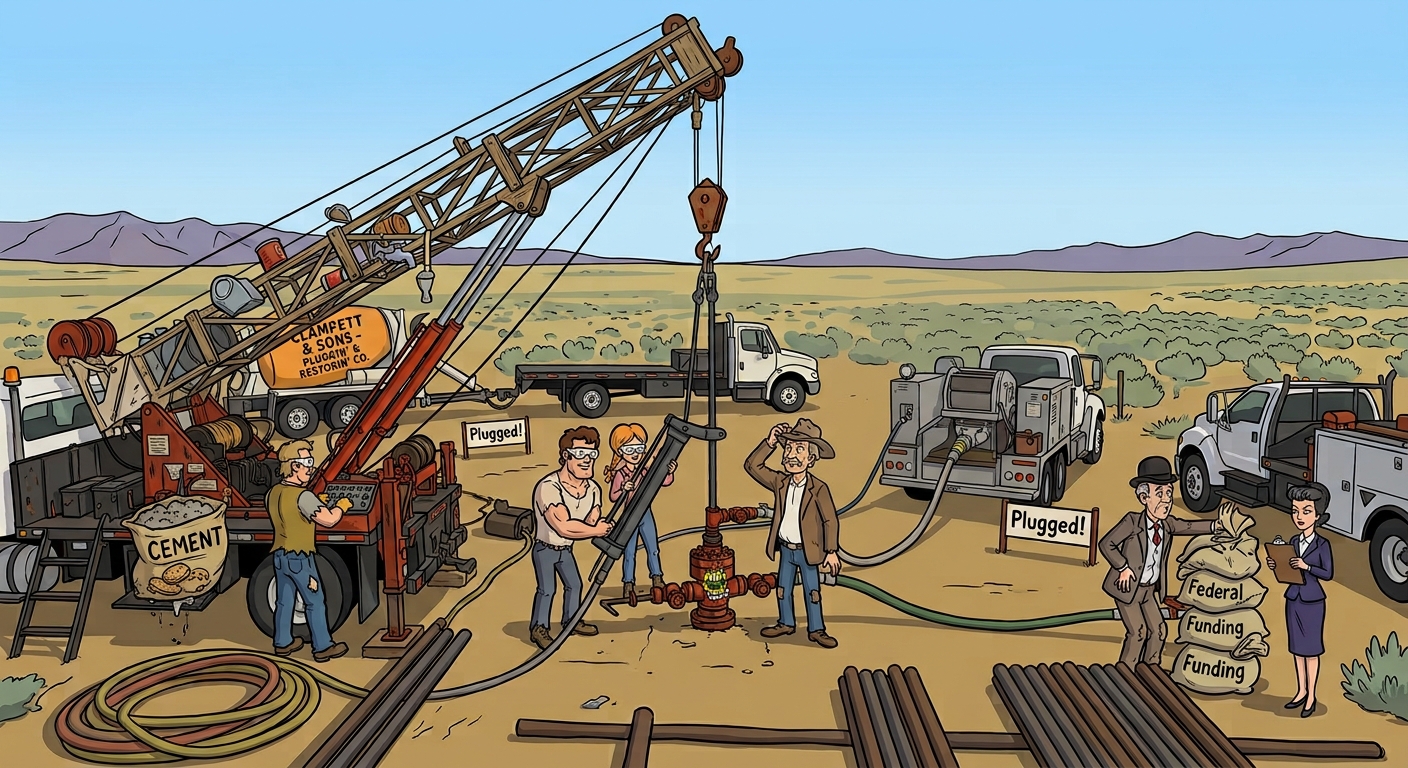
Congress set aside about $4.7 billion to plug abandoned oil and gas wells, but by the end of 2025 only about 40% of it had gone out, and states had plugged just over 10,000 of the roughly 142,000 documented orphan wells. In this update, Justin Williams and I look at the results state by state, whether the money was well spent, and what you can do if an orphan well is on or near your minerals.
Using the embedded player above, you can download the episode to your computer or listen to it here!
Be sure to also subscribe on Apple Podcasts via the link above and please leave us an honest rating and review. We read every one of them and sincerely appreciate any feedback you have. To ask us a question to be featured on an upcoming episode, please leave a comment below or send an email to feedback@mineralrightspodcast.com.
The sponsor for this episode is SS&C MineralWare:

MineralWare is the leading asset management platform trusted by thousands of mineral rights owners for managing minerals, royalties, and non-operated working interests. Know in seconds where your leases are, what’s active, what acreage is open for lease, and if you are getting paid what you’re owed. See a demo today by visiting mineralware.com.
The money is moving slowly, and the problem is bigger than we knew
Of the roughly $4.7 billion set aside, about $1.85 billion had been distributed by the end of 2025. That included $1.5 billion to states, $241 million to the federal public lands program, and $81 million to tribes. States reported plugging 10,257 wells with that money through mid-2025.
It is tempting to divide the money by the wells and call that the cost per well, but that overstates it, because much of the money awarded has not been spent yet. Where states have reported what they actually spent, the average was about $40,000 per well, according to a March 2026 industry analysis. An independent study of 2,150 plugged wells in six states put the average closer to $67,000. Both figures fit what I would expect for an older, vertical well, with a handful of complicated sites costing far more.
One statistic surprised us: the number of documented orphan wells jumped 54%, from about 92,000 in 2020 to nearly 142,000 in 2023. That does not mean more wells were abandoned. Much of the federal money paid for better records and for searching for wells that no one knew about, so we now have a more complete picture of the problem. Industry estimates suggest hundreds of thousands more undocumented wells may still be out there. Against that backdrop, 10,257 wells plugged is progress but a small fraction of the total problem.
Federal funding hit a rough patch
In January 2025, an executive order and a budget memo paused federal infrastructure and climate funding, including orphan well money, and some states with projects underway had work stopped. About two dozen state attorneys general sued. In March 2026, the appeals court largely upheld the order blocking the freeze, but it said it could not force the government to pay specific dollar amounts. Those claims have to be pursued in a different court. Money began moving again by spring 2025, and new grants went out later that year.
In July 2025, the Department of the Interior also rewrote the program rules and dropped some methane monitoring and environmental review requirements. Some critics argue that this just provides for less accountability and oversight. The Texas numbers make the case for the change, though. The Railroad Commission plugged 737 wells with its first $25 million grant, then 45% fewer wells with its second round, which came with added federal reporting requirements. Geology and environmental risks differ from state to state, so I think it makes sense to give states more room to decide which wells to plug first.
One piece of the program remains unresolved. About $1.5 billion in grants was designed to reward states that raise bonding requirements and hold operators more accountable, which ties directly back to episode 150. Those grants remain under federal review, and they are the part of the program most at risk.
Results vary widely from state to state
Wyoming plugged about 1,000 wells in a single year with its $25 million grant, according to a 2024 federal report. Officials expected that grant to essentially finish off the state’s inventory of roughly 1,500 orphan wells. Utah has funded plugging since 1992 and has only about 20 to 24 orphan wells today. Both show how much easier the problem is to manage when a state acts early and keeps at it.
Colorado’s results look very different, but the numbers need care. Colorado has been awarded about $50 million in federal grants, but it has spent only part of that so far. In the fiscal year ending June 2025, its orphaned well program spent about $15 million to plug 95 orphan wells. The money came from federal grants, operator fees, and BLM funding, with no state tax dollars. That works out to roughly $158,000 per well, which is high. At last report, a large share of the federal money was still under contract or waiting to be committed. Deeper and more complicated wells may explain part of the gap.
Elsewhere, Texas has been awarded the most, about $254 million through September 2025. Oklahoma plugged 982 wells in one fiscal year, and nearly all of them were paid for with federal grants at roughly $21,000 per well. Pennsylvania has received about $101 million through 2025, plus a new $115 million award in March 2026. It also reached its 400th plugged well, though that figure combines state and federal funding over about three years. Louisiana plugged 519 wells in about six and a half months after its program launched. Its documented count has since grown from about 4,600 to about 6,600, so its backlog is growing faster than the plugging.
Was it worth the cost?
If you have an orphan well sticking up in the middle of your field, the answer is obviously yes. Once plugged, the wellhead is cut off below plow depth and the land is usable again. Looking at the country as a whole, the answer is less clear. A study by Resources for the Future looked at 2,150 plugged wells across six states. It found the plugging cost $147 million, while the estimated benefits, from reduced methane leaks and higher nearby farm and home values, were only $30 to $40 million.
The study also found that for high-emitting wells, the benefits easily outweighed the costs. The methane data covered about 100 wells, and the benefit ranged from $1.4 million to $9.3 million against $5.9 million in plugging costs. That suggests the value is in going after the worst polluters first. Texas has a clear system for this, scoring wells on points and putting drinking water protection at the top. In some other states, a well gets plugged when a landowner calls, whether or not it is a high priority.
Costs should also come down with steady funding. One-time rounds of money mean a crew plugs wells, moves on to other work, and someone new has to be found for the next round. Ongoing funding and competitive bidding would let crews get faster and cheaper at the work.
What to do if you own minerals near an orphan well
Start with your state oil and gas agency’s website. Most publish a list of orphan wells and the criteria they use to prioritize them, so you can see whether your well is on it. Texas even has a map of plugged wells. If a well is causing problems, report it through your state’s complaint process and stick to the facts. Data showing that a well is leaking gas, water, or oil can move it up the list.
Before you push, though, understand the royalty tradeoff. Colorado runs a separate program that helps operators plug 142 low-producing wells before they become orphans, using up to $14 million in federal and state money. I do not always agree with that approach. If that well is your only source of royalty income and no drilling is nearby, plugging it ends your payments. That said, if drilling is active in the area, losing your last producing well lets the lease expire, which gives you a chance to negotiate a better lease for future wells.
The bottom line
There has been real progress, but it varies by state, and the biggest question is whether each dollar is going to the highest-priority wells in the most efficient way. Wyoming and Utah offer models that other states could learn from, and Colorado’s spending is worth watching as more of its money is put to work.
Resources Mentioned in This Episode:
- DOI, FY2025 Annual Report to Congress on Orphaned Wells
- Texas RRC, Federally Funded Well Plugging
- Pennsylvania DEP, Legacy (Abandoned and Orphan) Wells
- Colorado ECMC press release, 95 orphaned wells plugged
- Resources for the Future, cost-benefit study press release
- MRP 144: Solutions to the Orphan Wells Problem
- MRP 145: Abandoned and Orphan Wells with Professor Jim Crompton
- MRP 150: Colorado’s New Financial Assurance Rules with Neil Ray
Thanks for Listening!
To share your thoughts:
- Leave a comment or question below (we read each one and your question may be featured in a future episode)!
- Ask a question or leave us feedback via email.
To help out the show:
Click the Apple Podcasts Logo Above to leave us a rating & review. It really helps us reach those that need to hear this information and only takes a minute. We greatly appreciate it! Plus, you can get a shout out on a future episode!
Thanks again – until next time!
Disclaimer: This information is provided for general information purposes and should not be construed as financial, legal, or investment advice. For guidance specific to your situation, please consult with a qualified attorney, CPA, or financial advisor.