You signed the division order. Someone witnessed it. Then you discovered the decimal was wrong, and now you wonder whether you are stuck with it for good. A listener named Debbie asked me exactly that, and the answer may surprise you: a signed division order is rarely the final word. What matters is how quickly you act, because the statute of limitations for fixing a payment error could quietly erase the older months. In this episode, we explain what to do if your decimal is too low, what to do if it is too high, and how long you have to act in most of the oil & gas producing states.
Using the embedded player above, you can download the episode to your computer or listen to it here!
Be sure to also subscribe on Apple Podcasts via the link above and please leave us an honest rating and review. We read every one of them and sincerely appreciate any feedback you have. To ask us a question to be featured on an upcoming episode, please leave a comment below or send an email to feedback@mineralrightspodcast.com.
The sponsor for this episode is SS&C MineralWare:

MineralWare is the leading asset management platform trusted by thousands of mineral rights owners for managing minerals, royalties, and non-operated working interests. Know in seconds where your leases are, what’s active, what acreage is open for lease, and if you are getting paid what you’re owed. See a demo today by visiting mineralware.com.
Why a Signed Division Order Is Not the Final Word
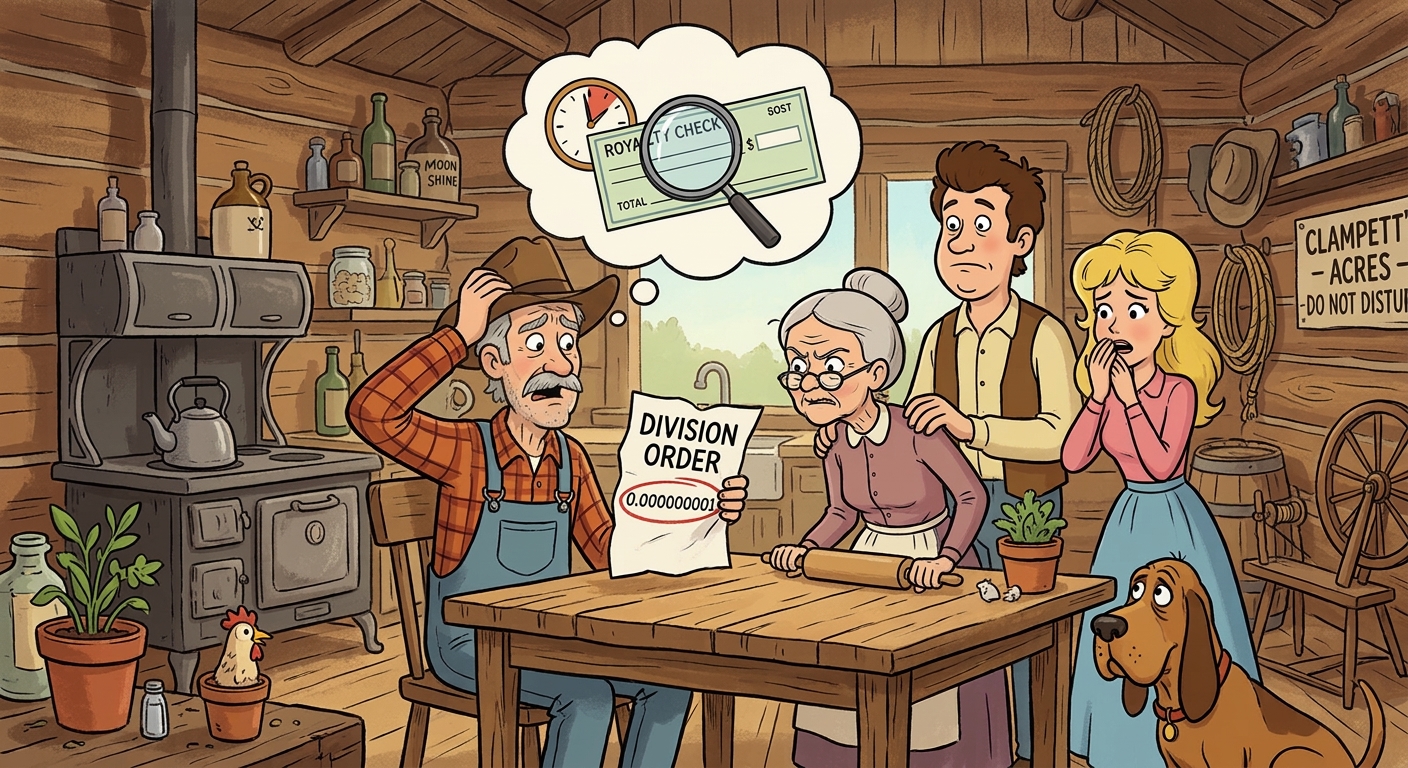
Debbie’s concern is a common one. She signed and had her Division Order witnessed, then found out later that her decimal interest was not correct. Her fear that the company would not correct it is a common one. The short answer is that she is not stuck with the lower number, but she does have to act. A signed division order generally governs until you revoke it, and it does not permanently change your lease. In Texas, for example, the courts say it binds underpaid owners until revoked. Each state handles the details differently, which is why the next steps matter.
How Wrong Decimals Happen
Your decimal is your share of the revenue from a well. In its simplest form, you take your net mineral acres, divide by the total acres pooled into the unit, and multiply by your lease royalty rate (we cover this in more detail in MRP 3: How to Calculate your Net Revenue Interest in 3 Simple Steps). Mistakes creep in through typos, a wrong royalty rate, or an ownership split that was recorded incorrectly. Changes also happen for legitimate reasons. A title opinion is a living document, and the operator’s attorneys may update it when new information comes to light, which could change the decimals for some interest owners in a well. The two moments we tell owners to watch most closely are when a well is sold to a new operator and when an operator changes its accounting system. If a new division order arrives with a different number at either of those times, ask why.
Your First Moves: Ask for the Math
Do not guess who to call. A division order usually names a division order analyst with a phone number and email address, and that person knows your well. Contact them directly and ask for the calculation behind your decimal and the documents that support it. You can also ask for a redacted copy of the portion of the title opinion that covers your interest. Then pull together your own deeds, probate paperwork, leases, and pooling documents, and have someone verify them. Once you are confident of the error, send written notice with your documents via email (or via mail). Keep that proof, because it starts your paper trail.
If the Decimal Is Too Low
This is the situation that worries most owners, because a lower decimal means a smaller royalty check every month. The key principle is that the signature does not lock you in. You can ask for a corrected division order and a payment adjustment, and you can revoke the order in writing if the operator refuses. In Oklahoma, a division order does not relieve the operator from following the lease. Each month of underpayment is its own claim, so waiting can cost you real money. If the operator will not fix it, escalate with the help of a qualified oil & gas attorney licensed in the state where your minerals are located.
If the Decimal Is Too High
An overpayment feels like good news, but it is usually temporary. If you own other wells with the same operator, they may correct your decimal and hold back your future royalties until the overpayment is repaid. This is an area where direct deposit matters. Operators often have authority to subtract prior corrections from your payments, and a paper check gives you more control. I have also seen a client keep receiving payments for a year after selling an interest because the buyer never notified the operator. If you see money you know you do not own, tell the operator, and do not spend it. If you spend it, you may have to find a way to repay it.
How Long You Have: Time Limits by State
The legal time limit (also referred to as the statute of limitations) may decide how far back you can collect, and it varies by state. The ones we covered:
- Texas: four years for a typical underpayment claim.
- Oklahoma: five years.
- New Mexico: six years for written contracts and four years for unwritten ones and most other claims.
- Colorado: about six years.
- Wyoming: up to ten years.
Do not count on getting extra time because you only just found the mistake. In many states, including Texas and Colorado, the clock starts when each payment was due, not when you noticed. If a payment was due in 2015 and you find the error in 2026, a six-year limit could mean that you may only reach back to around 2020. Case law changes, so confirm the current rule for your state.
Don’t Forget the Interest
Unpaid or late royalties can earn interest, and in some states the rate is steep. In Wyoming, for example, unpaid proceeds accrue interest at a penalty rate of 18% a year. On large underpayments, that adds up quickly. Operators rarely mention it on their own, so ask.
Where to Get Help
You can learn to check this yourself but that may not be right for everyone. In more complex situations, I have helped clients confirm their division of interest on their wells to ensure that they were getting paid correctly. A consultant can review your division order, gather the right documents, and confirm your interest through a series of calculations. When the dollars are large or the title issue is complicated, it may also make sense to bring in an attorney licensed in the state where your minerals are located. Because title attorneys can interpret the same deed differently if there is ambiguous language, a documented, well-built case matters. The National Association of Royalty Owners is also a good source of ongoing education on state rules and case law.
The Bottom Line
You are not stuck. A wrong decimal can be corrected, but do not delay. Notify the operator, if needed, get help confirming the mistake, and remember that even a small monthly error can turn into a large amount over four or more years. Finally, while a Division Order can be corrected, the statute of limitations in your state may limit your ability to claim underpaid royalties past a certain date.
If you need help from a professional, you can book a free initial consultation today with Matt to help you understand your options.
Resources Mentioned in This Episode:
- Mineral Management Basics Course (how to find and download important documents like deeds, leases, and well files)
- MRP 34: Important Documents for Mineral Rights and Royalties
- MRP 226: How to Use the Texas Railroad Commission Website
- MRP 227: How to Find Oil and Gas Info for Oklahoma
- MRP 343: How to Get Your Operator to Actually Answer You
- MRP 16: What You Need to Know about Oil & Gas Division Orders
- MRP 166: How to Read and Manage Your Royalty Statements
- MRP 97: How to Audit Your Oil and Gas Royalty Statements
Thanks for Listening!
To share your thoughts:
- Leave a comment or question below (we read each one and your question may be featured in a future episode)!
- Ask a question or leave us feedback via email.
To help out the show:
Click the Apple Podcasts Logo Above to leave us a rating & review. It really helps us reach those that need to hear this information and only takes a minute. We greatly appreciate it! Plus, you can get a shout out on a future episode!
Thanks again – until next time!
Disclaimer: This information is provided for general information purposes and should not be construed as financial, legal, or investment advice. For guidance specific to your situation, please consult with a qualified attorney, CPA, or financial advisor.